How has sentiment towards the PAP and the WP changed throughout the Raeesah Khan saga?
In this post, we analysed comments from YouTube videos to gather insights into how the public sentiment regarding the People’s Action Party (PAP) and the Workers’ Party (WP) has changed over time throughout the Raeesah Khan saga.
Sentiment Analysis
We start with a sentiment analysis of WP during the saga.
Figure 1. Sentiment Analysis of the WP
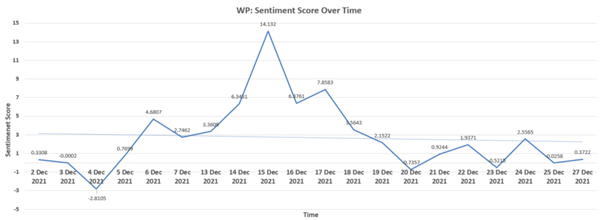
Sentiment turned negative from 2 December onwards and reached its lowest point on 4 December. However, sentiment skyrocketed from 13 December onwards and peaked on 15 December.
The low sentiment score on 4 December can be largely attributed to Raeesah Khan’s Committee of Privileges (COP) hearing on 2 December, where she claimed the WP told her to stick to her lie.
Her claims created frenzied discussions amongst netizens, with many chastising her failure to take responsibility alongside others who criticised the WP as a whole for its incompetence at managing the incident.
The sudden increase in sentiment score after 13 December is likely due to the COP hearings of WP’s leaders Pritam Singh and Sylvia Lim.
A large number of WP’s supporters seemingly emerged from the woodwork, expressing positive sentiments towards the WP, especially Singh. Many complimented Singh for the way he carried himself during the hearing; his wit, character, and verbal sparring abilities did not go unnoticed.
Ultimately, the overall sentiment towards the WP barely budged, effectively ending where it started as shown by the trendline in Figure 1.
Indeed, this scandal’s effect on the WP’s reputation has been minimal — at least from the public’s perspective. Its supporters seemed to have maintained their loyalties, holding strong to their belief in the WP.
Figure 2. Sentiment Analysis of the PAP
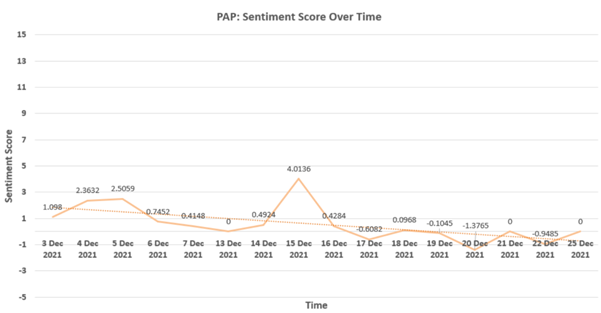
Figure 2 shows that sentiment towards the PAP jumped after 13 December and peaked on 15 December, before falling and reaching its lowest point on 20 December.
Although many netizens sided with the WP during the COP hearings, hence allowing the sentiment score to rise for the WP as seen in Figure 1 from 13 December onwards, this was also true for the PAP.
A sizable number of netizens expressed pro-PAP sentiments during the COP hearings, hence boosting PAP sentiment’s score from 13 December to 15 December.
A possible reason for sentiment falling so drastically on 20 December is public exhaustion.
Commenters mentioned how the entire saga was unnecessarily protracted by the PAP:
“They can spend so much on this 1 case but nothing can be done to find out about my biological parents. Seriously. Plus many years ago i was cheated close to $10,000 but case was close due to lack of evidence and the con man is still on the loose in society probably conning other women. ….”
“My question is if they spent so much time gruelling the Workers Party leadership, do they have time to think and handle serious issues of running the country esp economic policies, and covid19 cases and coastal protection and social issues etc.”
“It’s frustrating to see that when opposition does something bad the issue goes on to this extend but if it was pap, issue will be gone as fast as the smoke would disappear.”
Hence, this potentially led to a drop in sentiment towards the PAP.
It is worth noting that Khan admitted to lying in Parliament on 1 November, meaning that the entire saga had been ongoing for some 50 days as of 20 December.
From 17 December onwards, PAP’s sentiment score stayed in the negative range, suggesting that netizens were simply tired of the political mess.
Ultimately, PAP’s overall sentiment score fell substantially as seen by the trendline in Figure 2.
Some possible reasons for this include:
- As mentioned previously, the public may have simply been tired of the PAP’s prolonged investigation into the scandal.
Some frustrated commenters said:
“This entire COP is a waste of resources.”
“Can all we just agree that Khan was an idiot and move on please.”
“I go for worker party as pap just wasting people resources”
2. Perhaps, this scandal reflects how PAP’s popularity is dwindling. Just as how the PAP performed its worst during the 2020 General Elections, the fact that the PAP’s sentiment score has fallen over time during the Raeesah Khan saga suggests that the winds are changing in Singapore’s political landscape.
Some comments criticising the PAP include:
“Trying so hard to bring Pritam Singh down, this makes the PAP look and sound so stupid.”
“Overbearing PAP inquisitors”
“TCJ, being the Chairman, needs to be impartial. This entire COP episode is all skewed. PAP-infested COP needs to be upfront as to what their ultimate objective is.”
3. Edwin Tong. The Minister for Culture, Community and Youth has been criticised and memed online for his perceived arrogance, lack of courtesy, and bias during his COP hearings — especially during his meeting with Singh.
Some comments critical of Tong include:
“Edwin Tong is a manipulative person! How can he be a MP?!”
“Who this edwin ah? Seriously cut in people anaswering question but don’t waant others to cut his idiotic voice. I don’t like this kind of bully. Edwin Tong, you shouldn’t even have the right to sit there tbh. Irritating. Gosh. This just show this seat of committee just trying to feed words in these people mouth. Gosh. PAP do something leh. What the hell is this. They are not trying to determine more like assuming and accusing.”
“Edwin Tong is very condescending”
Sentiment Analysis of Entity
Figure 3 shows that Tong received a large number of both positive (26) and negative (18) comments.
Figure 3. Sentiment Analysis of Edwin Tong
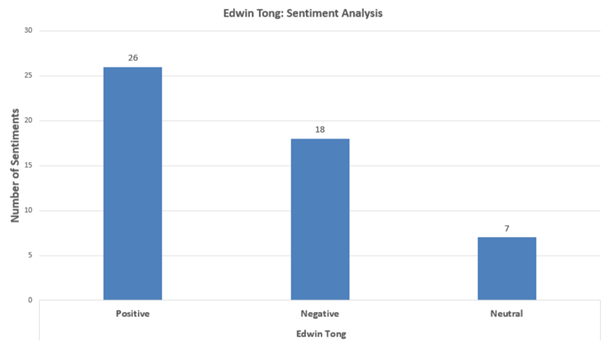
The negative comments are likely due to the aforementioned factor — many netizens deemed Tong to be overbearing.
However, the fact that Tong received a large number of positive comments is surprising, showing that there were many supporting Tong, and by extension, the PAP.
Those in favour of Tong expressed comments such as:
“Mr Edwin Tong is very intelligent and really very impressed.”
“Mr.Edwin Tong,a good job done professionally👍👍👍👍👍”
“Edwin Tong has done a great job probing these Workers Party leaders so as to expose their true colours. The whole world appreciates that.”
Emotion Analysis
Comments expressed varying degrees of emotions towards the WP and the PAP. The WP received more comments expressing anger whereas the PAP received more comments expressing joy and sadness.
Figure 4. Emotion Analysis of the PAP & the WP
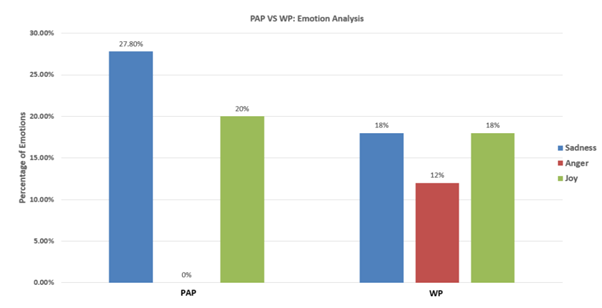
As seen from Figures 4 and 5, the WP received far more comments expressing anger (12%). Unsurprisingly, some were outraged at how the WP handled Khan’s scandal.
The PAP, however, received no comments expressing anger. Perhaps, this is due to the fact that the PAP was more of a spectator and judge during this incident, and had no direct involvement in Khan’s scandal. After all, it was the WP’s own mismanagement that resulted in this entire saga.
Figure 5. Emotion Analysis of the PAP
The PAP received more comments expressing joy (28%) than the WP (18%). Once again, this is likely due to the PAP’s supporters expressing happiness over the perceived ‘win’ from this incident. After all, the WP is the PAP’s opposition.
A sizable number of comments expressed sadness towards both the PAP (28%) and the WP (18%).
As previously mentioned, a possible explanation for this is because of many netizens’ view that the PAP was drawing out this incident to its benefit, leading to disappointment.
While the comments expressing sadness towards the WP are rather self-explanatory: Singaporeans, especially those who are pro-WP, were disappointed that this scandal even occurred in the first place.
Conversation Volume Analysis of all comments
Based on Figure 6, it seems like the public already sees the Raeesah Khan saga as old news.
Figure 6. Conversation Volume over time
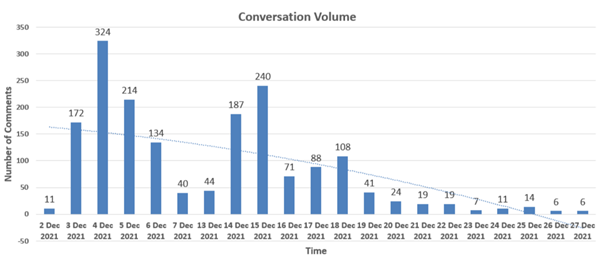
Overall, unless new revelations emerge from this scandal, the trajectory of the conversation volume is unlikely to change.
Indeed, this saga seems to be drawing to a close.