Meditation for Mental Health
Bill Gates advocates meditation. So does Oprah. And even the late Lee Kuan Yew engaged in this practice.
It seems that much of the world has been celebrating the powerful effects of meditation on the mind, with meditation-related phone applications such as Headspace being promoted on the app store.
In fact, Headspace was downloaded 3.34 million times in the first quarter of 2021 alone. The app became so popular that it was even given its own documentary series on Netflix.
Besides, meditation has also made an unexpected collaboration with virtual reality, with the industry expected to be worth $3.9 billion by 2023.
In this article, we look at the science behind meditation and then use HAMI to analyse 1,161 comments from six YouTube videos to gain deeper insights into the perception of meditation in Singapore.
The Benefits
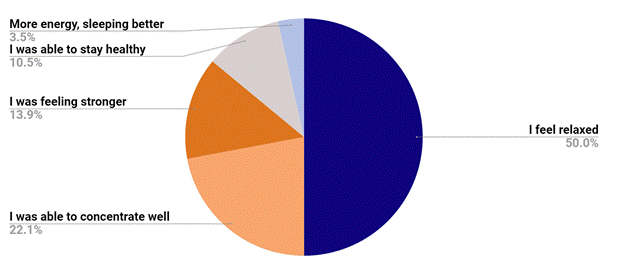
Figure 1 below shows several reported benefits from a meditation practice, with the primary one being relaxation.
Figure 1. Benefits of meditation
Data source: Integrative Cancer Therapies
Meditation has long been associated with higher consciousness — where a person is one with the world, fully in-tune with everything; content with nothingness; and seemingly aware that life is as beautiful as it is meaningless.
Sam Harris, a neuroscientist and philosopher, says that meditation allows for the management of emotions and that being in the now simply makes life more pleasurable. Indeed, studies show that meditation is a powerful tool for improving our mental states.
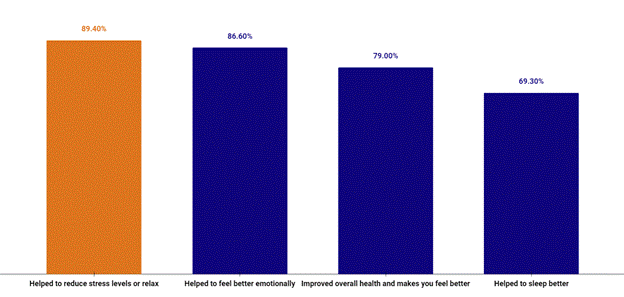
Figure 2 below shows that meditation’s main benefit is in reducing stress levels or enabling relaxation.
About 7 in 10 Singaporeans found 2021 to be the most stressful year for them. And a 2019 survey by Cigna 360 Well-Being showed that 92% of Singaporeans are stressed, 8% higher than the global average of 84%.
Hence, we can adopt meditation to better cope with our busy lives.
Figure 2. Other benefits of meditation
Data source: Scientific Reports
What do People Think of Meditation?
HAMI Analysis
Are the benefits of meditation cited in the studies above actually felt by people?
As seen from Figure 3, meditation is well-received amongst netizens, with 756 comments expressing positive sentiments (65.1%) while a very small proportion expressed negative sentiments, at 147 comments (12.7%).
Figure 3. Sentiment Analysis of comments
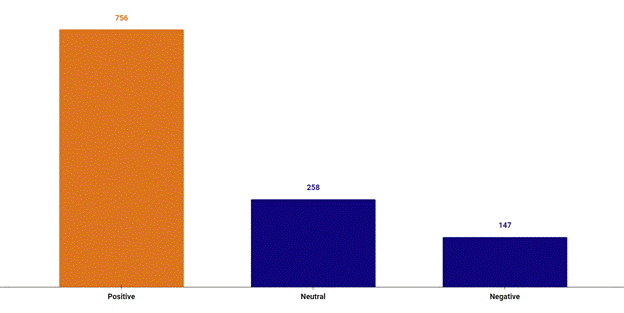
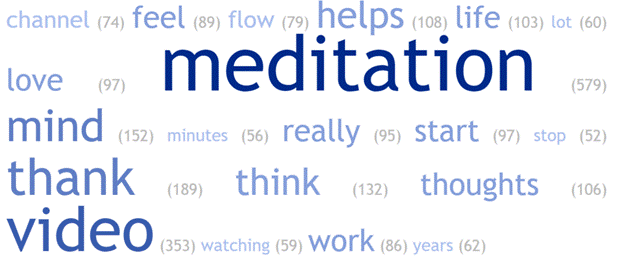
Figure 4 shows the top 20 terms taken from the comments of the videos analysed.
Notably, the terms used were mostly to praise the meditation videos and involved a shared appreciation for meditation’s mental health benefits.
Figure 4. Top 20 terms
Some examples include:
“I meditate everyday my mind is sharper than a surgeon’s blade”
“I’ve been meditating for three weeks 3-4 times a week and I’ve noticed that when I’m in situations at work where I used to freak out and get super stressed I’ve been able to calm myself and focus on what I need to do in that moment to help the situation.”
“Meditation is no gimmick . It really is a powerful technique that really helps us keep calm enjoy more and be more happy . Combing this with diet sleep excersize and religion ( whichever helps u ) really does wonders .”
“There are some great benefits to meditation, through finding out about meditation myself I got through a deep depression. Great video to explain it all :)”
“I have been personally meditating for over 10 years…and I can tell you from my personal experience that…if everyone in this world starts meditating for 30 minutes a day..we can bring down world’s violence, depression and drugs use by over 95%…”
“Great video!!! Meditation is our highest functioning state!”
Based on HAMI’s analysis, it seems that most netizens’ comments corroborate the research findings that meditation has a multitude of benefits on our minds.
What even is meditation?
But what is meditation?
Meditation is loosely defined nowadays — from counting breaths, to bringing one’s attention to the current moment (i.e. being in the now), to simply watching one’s thoughts, or even engaging in prayer.
Undoubtedly, the image of meditation as a spiritual Eastern practice has changed dramatically in today’s world of commercialised self-love. For example, Buddha saw meditation as a journey towards enlightenment, but today’s view of it is rarely one of such grandeur.
For clarity’s sake, meditation shall be defined as “a set of techniques that are intended to encourage a heightened state of awareness and focused attention.” Essentially, meditation here is about being mindful of the present moment, which betters one’s mental health.
Meditation is not magic
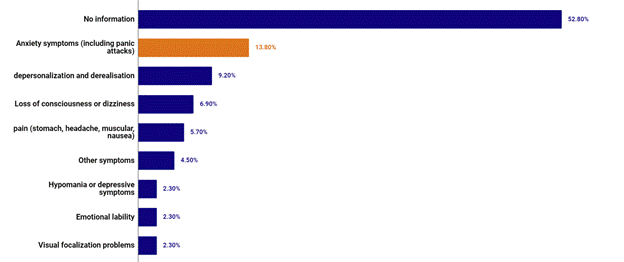
Unfortunately, as seen below, some studies show that meditation can be detrimental or undesirable for certain people.
Figure 5. Unwanted effects of meditation
Data Source: PubMed
Figure 5 demonstrates that some people may suffer from unwanted effects when meditating, with 13.8% of participants reporting anxiety symptoms.
This is alarming, considering that most meditate to alleviate mental health issues like anxiety. Thankfully, meditation is just one of the many ways to better one’s mental health. Besides meditation, one can always try alternatives like ‘revenge travelling’ or exercising.
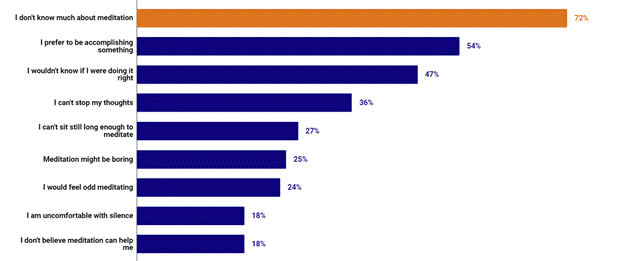
Furthermore, people cite numerous reasons as to why they do not meditate.
Figure 6. Barriers to meditation
Data Source: Integrative Cancer Therapies
Figure 7 shows that 72% do not know much about meditation, and hence cite is a barrier.
However, many barriers to meditation seem to just be a healthy scepticism of what is deemed ‘mystical’. But a few or even just one meditation session should be able to change such a mindset.
How can you meditate?
The simplest way to start meditation, at least based on the definition given earlier, is to have a guided session.
Using phone applications such as Black Lotus, Headspace, Waking Up, or Balance is a good place to start. The sessions for beginners are easy to follow and take less than 10 minutes a day.
And if using phone applications does not appeal to you, one can always try a physical class.
Ultimately, it is as Sam Harris says, “Our minds are all we have. They are all we have ever had. And they are all we can offer others.”
Hence, take charge of your mental health. If you have not meditated before, why not give it a shot?