Objectives:
- To analyse population trends and understand demographic shifts amongst Singaporeans and non-resident populations.
- Find data-driven insights to inform future policy recommendations.
Summary & Key Insights:
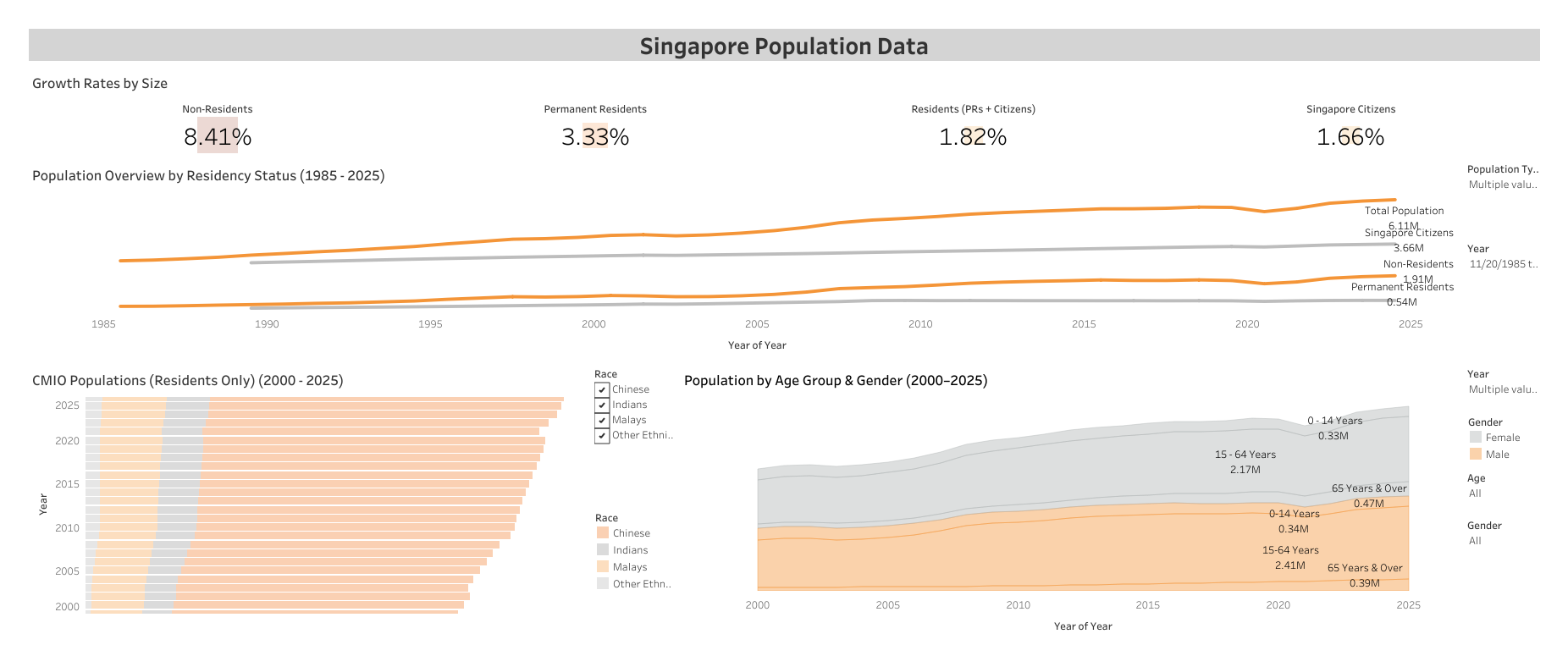
Singapore’s total population has risen steadily from 1985 to 2025. The most significant increase came from non-residents (8.41% growth overall). Citizen growth, contrastingly, has grown at a modest rate (1.66%) over the same period. Demographically, the ageing population is expanding at a faster rate than younger segments. Those labelled ’65 Years & Over’ account for 0.86 million of the total population, while those labelled ‘0–14 Years’ account for only 0.67 million of the total population. The Chinese population remains the largest, followed by Malays, Indians, and Other Ethnicities — by proportion, Other Ethnicities rose substantially by 200% from 2000 onwards, followed by Indians (46.15%), Malays (23.91%), then Chinese (23.90%).
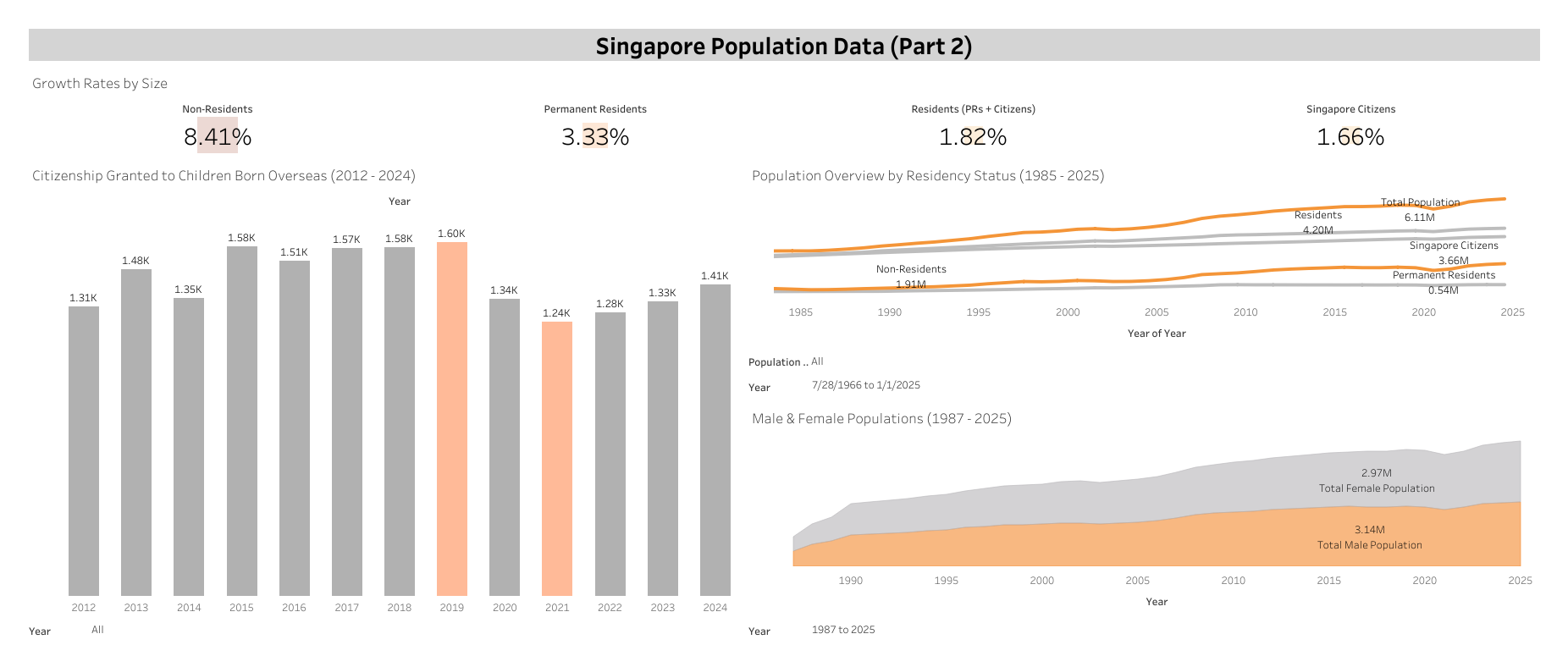
The male population has been consistently higher than the female population since 1987. There is also a positive trend when it comes to citizenship granted to children born overseas, where the number peaked in 2019, fell to its lowest in 2021, but has risen steadily since then.
Some key insights are:
- Non-resident population (8.41%) is the main driver of population growth; suggesting Singapore’s continuous and growing need for foreign labour. Singapore likely continues to be an attractive destination for expatriates and international students as well.
- Citizen growth is slow (1.66%); birth rates will remain a policy concern. With rising economic pressures and changing societal attitudes, Singapore could face long-term demographic constraints similar to those seen in countries like South Korea, where younger populations have become almost impossible to replenish. Hence, the cycle of hiring more foreign workers will only continue since there is a lack of local workers.
- The ageing population will only continue accelerating. Across both genders, the ageing population (65 and older) is far greater compared to the younger population (14 and below). Singapore’s healthcare and social service sectors will continue to be pressured. The cycle of hiring low-cost foreign labour in social service and healthcare sectors will likely continue, since these fields (especially Social Work and Nursing) are unpopular with locals.
- The CMIO distribution remains stable, but Other Ethnicities have skyrocketed, since most of them are likely non-residents.
Other insights:
- Singapore’s male population is noticeably larger than the female population, largely due to male-dominated foreign labour inflows. However, it is worth examining whether international students and expatriates also skew male, as these groups may further influence the gender imbalance.
- The rising non-resident and immigration population may correlate with increasing xenophobia and racism, similar to European nations. Singapore must implement cohesion policies and integrate the foreign population in a way that balances locals’ expectations (e.g. employment) while also protecting immigrants.
Recommendations
- Strengthening job security: The government must create more jobs via traineeships, host more job fairs and career counselling, and ensure fairer hiring processes through stricter laws and monitoring. Doing so can rectify negative attitudes toward immigrants who are perceived to be taking locals’ employment opportunities.
- Driving educational awareness: Adopt episodic framing to showcase immigrants’ lives for greater empathy, leverage religious leaders & online influencers to dialogue with disgruntled locals, and stem early signs of xenophobia through Character and Citizenship Education classes in schools.
- Continuing to monitor online sentiment: Track sentiment shifts to determine if long-term policies are successful.
- Increasing cohesion opportunities: Immigrants should be encouraged to mix with locals through dialogue sessions and community activities.
Conclusion:
Singapore’s population trends point to steady growth but deepening structural challenges. Non-resident inflows continue to drive expansion; slow citizen growth and a rapidly ageing population signal long-term pressure on labour supply, healthcare demand, and social support systems. The dashboards presented here exhibit these underlying shifts clearly and can support further scenario-planning work. Continued monitoring of demographic patterns — especially labour composition, gender balance, and youth cohort size — will be essential for informed policy and planning decisions. Notably, xenophobic sentiments must be dealt with quickly to prevent destabilisation of Singapore’s harmony; online monitoring can be done to identify such attitudes early.
Methodology & Notes
- Cleaned raw population time-series data (varied based on SingStat data) using Excel.
- Combined multiple datasets: residency status, CMIO, age-gender groups, and more in Excel and Tableau.
- Created two dashboards targeting high-level trends + demographic composition in Tableau.
- Chose line, area, and bar charts to highlight population data.
- Prioritised readability and professional, stakeholder-friendly colour coding.
Data retrieved from SingStat (view here).