Love And Population: More Sex Positivity, More Singles
Despite our seemingly more open attitude towards sex, why is it that singlehood continues to rise?
Singaporeans, especially the younger generation, seem more open to sex: things like one-night stands, pornographic consumption, or self-pleasure do not seem as taboo as before.
With such openness, one would assume that finding relationships — from polyamorous ones to the traditional, monogamous sort — would be easier.
Moreover, sex positivity is further complemented by the advent of dating apps and our increased connectivity. Indeed, social media (the very term) makes it easier than ever to meet new people and forge romantic relationships.
If this is the case then, why is singlehood rising?
More singles in Singapore
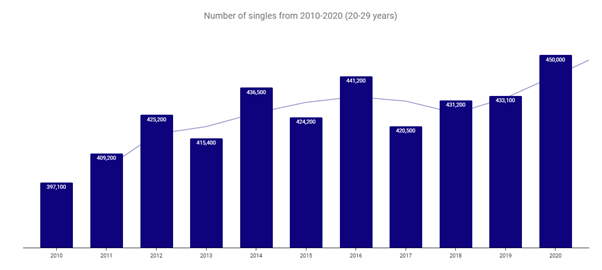
The 2020 census revealed that the proportion of singles increased substantially in Singapore, especially amongst the 20-29 age group.
Figure 1: Singlehood statistics among Singaporeans aged 20-29 years
Data source: SingStat
As shown in Figure 1, from 2019 to 2020, there were 16,900 more singles. Singlehood has risen at a staggering rate from 2010 to 2020, from 397,100 to 450,000 — a 13.3% rise.
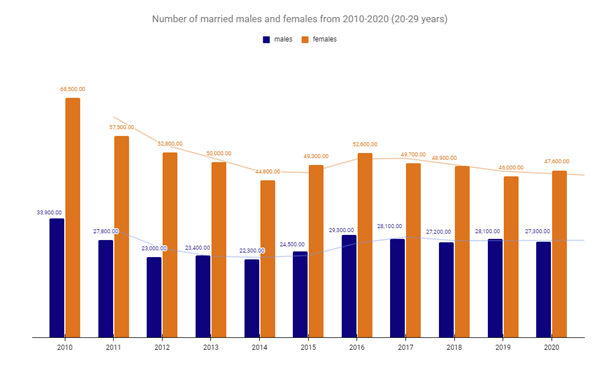
As depicted in Figure 2, marriage rates from 2010 to 2020 also fell. For females, it plunged from 68,500 to 47,600, while for males, it fell from 33,900 to 27,300.
Figure 2: Marriage rates for males and females in Singapore
Data Source: SingStat
Hence, sex positivity does not seem to be helping in building relationships. Instead, singlehood is ironically increasing alongside falling marriage rates in Singapore, especially amongst the younger generation.
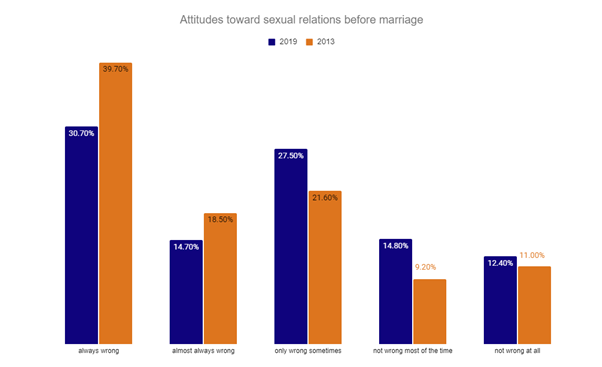
Oddly, Figure 3 shows that Singaporeans are more accepting of sex before marriage. One would think that this means more people are having sex and hence having relationships.
Figure 3: Slightly more open attitude towards sex before marriage in Singapore
Data source: LKYSPP
From 2013 to 2019, the percentage of Singaporeans who found sex before marriage to be ‘always wrong’ fell from 39.7% to 30.7%, and those finding it to be ‘not wrong at all’ increased from 11% to 12.4%.
Or perhaps this is an erroneous assumption — that relationships and sex go hand in hand. After all, Singaporeans may simply be having sex outside of relationships, unwanting of its commitment.
But why does this matter?
It matters because amidst these shifts in attitudes, relationships take a backseat, and sex positivity in the form of casual sex (which is far less time-consuming than building a relationship) becomes more popular.
A rise in singlehood means that it will be harder to resolve the ageing population issue in Singapore. It also means that more people will suffer the perils of singlehood — being single, especially for men, leads to a variety of problems down the road.
Surplus of men, shortage of women
It is fascinating that there are more single males than females in Singapore.
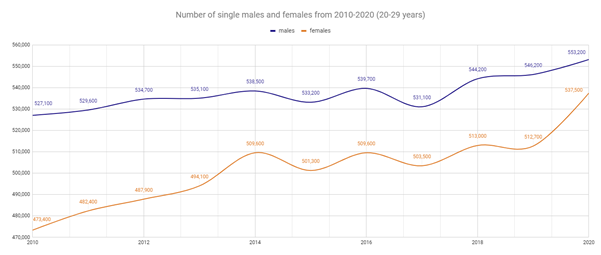
Figure 4: In Singapore, single males outnumber single females
Data source: SingStat
As seen from Figure 4, single males greatly outnumber single females. In 2020, 553,200 of the male population was single, while 537,500 of the female population was single.
In fact, throughout 2010 to 2020, there has never been a year where single females outnumbered single males.
Jordan Peterson, a clinical psychologist, provides several reasons for this phenomenon of more young single males than young single females:
First, biologically-speaking, it is only natural that more young males than females are single. Females are simply pickier about potential mates due to them having the capacity for childbirth, something which males do not have to worry about.
Second, the advent of porn (which is consumed by more men than women) has deprioritised real relationships. The online unreal has displaced if not replaced the offline real.
Third, Peterson argues that young men are simply not trying hard enough. He cites the need for self-improvement and resilience, in which men need to better themselves by improving their fashion sense, intellect, confidence and physicality in order to attract women. Also, the need to be unafraid of rejection is of paramount importance — something which most men will inevitably face when dating.
Furthermore, the dating game is imbalanced: young men (categorised as those between the ages of 18 and 29) form a much larger proportion of people looking to date at 61%, while young women only make up 38%.
This skewed distribution will mean that more young men end up unwillingly single compared to young women. And unlike females, males are less content with being single.
The depressing world of incels

What happens when a bitter, hopeless and likely isolated male is unable to find a date, have sex, or get into a relationship?
Incels (involuntarily celibate men who are angry that they are unable to have sex or find a girlfriend) are not just angry school shooters in the US. Hardwarezone and Reddit have their fair share of Singaporean incels.
Some blame Singaporean women for their high standards, being ‘White-washed’ (i.e. they only want White men), or for their gold-digging tendencies. Unfortunately, there are a fair number of them attacking women and posting misogynistic comments.
But this is not the full picture: some are simply self-proclaimed incels who feel depressed about their singleness while others blame society for placing physicality on a pedestal. Not all harbour sexist sentiments.
Additionally, for some, joining an incel community is a form of camaraderie, and a way to stave off loneliness.
Indeed, Merriam Webster defines incels as: “a person (usually a man) who regards himself or herself as being involuntarily celibate and typically expresses extreme resentment and hostility toward those who are sexually active”.
Note the word ‘typically’ — not all incels equate to dangerous, misogynistic, and bitter men.
Analysing Incel-related comments with Hami
Using Hami, we analysed 647 comments from 3 Reddit threads, 3 Hardwarezone forums, and 1 YouTube video. What does the analysis say about how people perceive incels and incels’ complaints?
Figure 5 shows that netizens frequently used terms that were unsurprising like ‘’incel’’ (85 times), “guys’’ (95 times), and ‘’girls’’ (126 times) when talking about incels and the dating scene in Singapore.
Figure 5: Frequency of overall keywords

However, what is striking are the terms “expectations’’ (22 times), “bbfa’’ (47 times), and “foreign’’ (21 times).
A fair share brought up the point that Singaporeans had problematic dating expectations.
Some examples include:
“But it gets better, women were bashing men who were against paying for dates etc, calling them losers destined to be forever alone. My goodness!highly agree to this. those who bash = red flag. those who expect full payments etc = red flag..”
“Some people complain why they are still single. But it seems like there are people who are single precisely because it is their doing. Their views/expectations on dating/relationship is simply unrealistic”
“… Oh please. I think you’ll find COUNTLESS of anecdotal experiences from sg guys and foreigners who realise how demanding and high the expectations of sg girls are …”
Besides, the term ‘’BBFA’’ was brought up, meaning Bui Bui Forever Alone, in reference to people who are fat, lonely, and single.
A few instances include:
“I am no incel, but I am definitely on the BBFA spectrum.I empathise with the incels but the poison goes both ways. Beauty standards for females are so high that many men are not interested in normal looking girls. Porn being so prevalent it makes it hard to dissociate for men who consume porn on the regular when they cannot find real relationships.”
“Very sad days. Now I am bbfa redditor, truly oppressed class”
“Most people are just saying it for fun. I’m not fat and I’m married. I often call myself bbfa there. Sometimes I also call myself Andy Lau.”
It is also notable that netizens used the term “foreign”, usually in reference to how female Singaporeans prefer foreigners, especially White men.
Some comments include:
“Can confirm. I am one ugly son of a bitch. But I am white. I’m invisible to women in my home country. But the attention I receive from hot Singaporean/Asian women is confusing/startling/overwhelming.”
“Most local women in Singapore ( and this is purely my personal observation) are simps for White dudes.”
“In my experience, local women may hate local men. They fawn over white guys and find locals to be ‘ugly’. It may be due to the whitewashing from young …”
Such comments bring to light the excuses some Singaporeans make for being single — blame the high standards of society, or blame the ‘ang moh’ for stealing potential partners.
It is thus unsurprising that some men have given up and choose to vent their frustrations online.
It is as this commenter says:
“Someone who wants to get laid/ find a romantic partner but can’t.So I guess they’ve tried time and time again but get rejected and turn to the echo chambers ( incel forums etc ).”
Summary analysis
Despite some negativity, most of the comments still remain level-headed as seen from the summary analysis below:
Some (both genders) may take that to be the new norm with which to judge themselves and others withRe 2: see above – kpop is a new phenomenon, after all”, “However the reason behind emotionally vulnerable young men buy into incel rhetoric and decide that it’s only looks that matters (not their vanilla personalities, for instance), is in part due to how they’ve seen people at that age bracket go nuts for these hypersexualized physiques.
“, ‘Sometimes you gotta let Mother Nature take its course, we’ve reached the point where the survival of the fittest or smartest doesn’t apply to us anymore just pray hard we won’t end up become a idiocracy comedy film.Now back to the main part, these happens because many people follow the trends like “I hate all men” or got knows what other movements
Most of the self-proclaimed incels, beneath their veil of self-deprecation and edgy comments, seem to believe that it is better to try their hand at love rather than to give up entirely.
And this is fantastic news: a man who manages to cling on to hope (regardless of how tiny a sliver it is) will likely avoid devolving into another Elliot Rodgers.
A lonely future awaits us
We have seen the reasons for singlehood as well as its problems.
It is becoming more acceptable to be single: casual sex will continue as long as we have dating apps; both male and female Singaporeans seem disenchanted by each other’s high expectations; and as mentioned previously, our priorities are changing.
Furthermore, sex positivity in the form of accepting self-pleasure will lead to less incentive in finding a relationship. The future appears headed to one of sex robots and Virtual Reality porn.
If so, it would suggest that singlehood will continue on its rising trajectory in Singapore.